
Smallcap funds have emerged as the primary beneficiaries of the systematic investment plan (SIP) wave in Indian mutual funds over the past five years, with their SIP assets surging to approximately 1.83 trillion by March 2026, a fivefold increase.

If India does get $100 billion a year in FDI, it would be a game-changer in every possible way. FPIs would come rushing back, AI or no AI, points out Debashis Basu.

'Since the category has a limited track record, assess the fund manager's experience across equity and debt market cycles rather than relying only on past returns.'

Net investments into equity mutual fund schemes in India remained elevated at approximately 38,440 crore in April, despite a slight dip from March's high and a 3% month-on-month decline in Systematic Investment Plan (SIP) inflows.

"When you have more liquidity than good investment opportunities, there is no reason for MFs to sell a winning trade."

In November, six primary market issuances accounted for more than 13,000 crore of net equity investments by MFs.

Jio BlackRock Asset Management Pvt Ltd, a 50:50 joint venture between Jio Financial Services Ltd (JFSL) and US-based BlackRock, has received regulatory approval from the capital market regulator Sebi to commence operations as an investment manager for its mutual fund business. The Securities and Exchange Board of India (Sebi), vide letter dated May 26, 2025, has granted the certificate of registration to 'Jio BlackRock Mutual Fund' and approval to Jio BlackRock Asset Management Private Limited to act as the Asset Management Company for Jio BlackRock Mutual Fund, JFSL said in a regulatory filing.
Mutual fund industry extended its bull run in 2025, adding a staggering Rs 14 lakh crore to its asset base and pushing total AUM to a record Rs 81 lakh crore by November, powered by surge in retail participation and record SIP inflows. Venkat Chalasani, chief executive officer of AMFI, told PTI that the industry's outlook remains positive, with steady SIP inflows continuing to offset foreign portfolio investor outflows and strengthening market resilience.

Mutual fund investment through systematic investment plans (SIPs) has surged to an all-time high of Rs 3.34 lakh crore in 2025, driven by growing investor appetite for disciplined, long-term wealth creation.

Liquidity stress in smallcap funds has fallen to its lowest level since February 2024, with the average time to liquidate 50% of portfolios dropping to 27 days in June from a peak of 44.2 days in January 2026, driven by a sharp recovery in smallcap stocks and increased trading volumes.

Largecap, flexicap, and balanced advantage funds together recorded a net inflow of Rs 9,363 crore in August, representing a 70% increase from the previous month's total.

Net SIP inflow is calculated by subtracting redemptions from gross SIP investments.

Net inflows into equity mutual fund schemes moderated in FY26, falling by 27 per cent to about 3 trillion till February, as choppy markets and global uncertainties prompted investors to shift towards safer options like hybrid funds and gold ETFs.

Smallcap funds give investors access to businesses that can grow much faster than the broader economy.

For the first time in a decade, inflows into equity mutual funds (MFs) decoupled from the past performance of the equity market, as investors continued to pour money into the market unperturbed by lacklustre returns.

The good news is that you don't need to spend hours manually comparing every scheme. In this article, we have explained how you can shortlist a winning fund in a few minutes by evaluating some crucial parameters.

'The rise in SIP contributions has created a pool of long-term MF assets that can be pledged for loans.'

Domestic institutional investors (DIIs), driven by the popularity of mutual funds, have emerged as significant stabilising forces for Indian capital markets amidst global volatility and foreign portfolio investment (FPI) outflows, according to Sebi whole-time member Amarjeet Singh.

The initial public offer (IPO) of SBI Funds Management Ltd was fully subscribed on the second day of bidding, receiving bids for 1.17 times the shares on offer, with strong interest from non-institutional investors and anchor investors.

'If their allocation to certain segments have become high due to strong returns over the past three-four years, they should rebalance their portfolios and bring them in line with their long-term asset allocation.'
SBI Funds Management, India's largest asset management company, has set its IPO price band between 545 and Rs 574 per share, valuing the company at 1.2 trillion. The management explained the 'moderate' valuation aims to instil investor confidence amidst market uncertainty, while also highlighting plans for AI integration, expansion into GIFT City, and new alternative investment funds.

The factor fund launch spree by mutual funds (MFs) is moving from the passive to the active space. Two new fund offerings (NFOs) - ICICI Pru Active Momentum Fund and Bandhan Multi-Factor Fund - are currently open for subscription. Sundaram MF's multi-factor fund NFO closed this Wednesday.
Net mutual fund inflows into active equity schemes in India plummeted by 40 per cent month-on-month in May, reaching a one-year low of 22,908 crore, primarily due to weaker lump-sum investments and increased redemptions amidst significant market volatility and global uncertainties.

AUM heavyweights SBI, HDFC and ICICI Pru flex muscle, adding Rs 2 trillion+ each.

Shares will be allocated across different institutional investors, including domestic mutual funds, other domestic institutions and FPIs.

The number of companies had touched a low of 792 in July 2020 amid heightened uncertainty because of COVID-19.
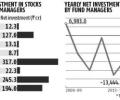
After relentlessly selling shares for most of 2013, India's equity mutual fund managers have turned buyers in the fag-end of the year.

BAFs seek to offer a smoother experience across market cycles, not the full upside of a bull market.

It's time to start planning your tax investments. Here are some new tax saving funds funds that have hit the market.

Axis Bank has opened 50 new branches across India, while Abakkus Mutual Fund has surpassed Rs 10,000 crore in AUM. YES Bank launched a new credit card for women, and J&K Bank partnered with HDFC Life to enhance its insurance offerings, showcasing significant growth and strategic developments in the Indian financial sector.

'Growth for some companies has been hard to come by and this is a smart way to get there.'

A primer on tax you pay on your mutual fund gains

'The Rs 30,954 crore inflows recorded in May 2026 reflects around 16 per cent year-on-year rise.'

Capital markets regulator Sebi has permitted mutual funds to again invest in foreign stocks within the aggregate mandated limit of $7 billion for the industry. This came in the wake of a major correction in global markets that brought down the valuation of international stocks. In January, Sebi had asked mutual fund houses to stop taking fresh subscriptions in schemes investing in overseas stocks. The directive to stop subscription was mainly on account of the mutual fund industry crossing the mandated limit of $7 billion for overseas investments.

'Every period of excessive optimism eventually gives way to a correction, while periods of extreme pessimism often create the best investment opportunities.'

Let reason, not emotion, guide your decisions.

Issuers have allotted nearly four times as much to mutual funds (MFs) as they have to insurance companies in recent quarters. MFs invested Rs 21,976 crore as anchor investors in initial public offerings (IPOs) on a trailing four-quarter basis, according to data from Prime Database.

HDFC Bank's share in active mutual fund schemes has fallen to multi-year lows, despite overall MF ownership in the bank rising, as the stock faces weak performance, soft margins, and governance concerns.
Equity funds like to identify newer avenues of investment and hence they create products around those new avenues. In the second part of this series, we look at the styles and themes of MFs.
